ORDER NOW MORE INFO AUTHORS REVIEWS E-MAIL HOME
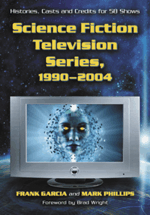
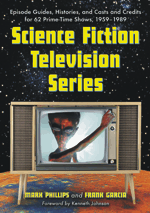
Episode Guides, Histories, and Cast and Credits
for 62 Prime Time Shows, 1959 through 1989
by Mark Phillips and Frank Garcia

The Science Fiction Television Series Press kit (c. 1996)

"What happened to those actors? How did these shows get created and why did they go off the air? Who are some of the now-famous guest stars who had bit roles on these shows? What are the untold backstage stories? Those were the things that Frank Garcia and I were interested in finding out when we decided to do this book," says Mark Phillips.

The information in this reference volume was painstakingly researched, weeding out errors in press kits and other source material. At the same time, the authors avoided analyzing the quality of the shows. "You'll find few sanctimonius pronouncements of a show's quality or lack of," says the authors. "The readers can make their own determinations as to if a show was a classic or a lox."

"What I'm most happy about in this book is the fact that we gathered so many interesting, varied stories and anecdotes directly from the filmmakers and actors who experienced them," says Frank Garcia. "Many of these tales are told here for the first time because no one has bothered to ask them!"

The authors are pleased to credit the Internet in helping make the project possible. Certain information presented in the book is not available in any published form, except in the hands of fan collectors. With access to the Internet, the authors were able to network with collectors and  "series experts" who have complete videotape libraries of specialty TV shows.

The authors are also grateful for the existence of the U.S. specialty TV network The Sci-Fi Channel. SFC broadcasted many series documented in this book, providing an invaluable research tool.

In cases of short-lived, obscure series, such as Aaron Spelling's The New People, information had to be secured from scratch,  which meant finding technicians who had old casting sheets with writer and director information.  "In some cases, you almost had to be a detective, finding lost material and lost people," says Phillips, who made a trip down to Los Angeles during the book's later stages to dig up information.

The goal was also to make the book an entertaining read as well, with dozens of new anecdotes about every show. A few examples:

  • When a hesitant ABC executive informed the crew of Darren McGavin's Night Stalker series that they had been cancelled, the entire company, having endured a year of nightmarish production problems, stood up and applauded.
  • A writer for the ABC television series The Phoenix found that his scripts were being mysteriously cancelled. He discovered, 10 years later, that a network executive, whom he had punched in the nose during a 1955 school yard brawl, was still holding a grudge and trying to destroy his writing career.
  • Rod Serling was devestated by letters from parents, charging that his TV series, Night Gallery, was causing severe psychological damage to the minds of America's youth. Serling placed the blame on Universal Studios, which he felt was turning Night Gallery into a horror show.
  • Harrison Ford was rejected for The Six Million Dollar Man because the studio felt he wasn't right for an action series.
  • TV's Planet of the Apes: CBS President William Paley didn't want "a show about monkeys" on his network, but his executives convinced him the series, based on the successful films, would be a smash hit. When the costly series bombed, the executives quickly swept the show's carcass under the mat and one network man stated, "I guess the only people who want to see apes on TV are those who own zoos."
  • Not well known trivia about the popular Incredible Hulk series, is that Lou Ferrigno was not the original choice to play the jolly green monster. It was actor Richard Kiel. But when the young son of Universal Studio's President saw the footage, he remarked, "That's not the Hulk!"
  • Blacklisted in Hollywood after his butler accidentally insulted a movie mogul, former silent screen star Francis X. Bushman languished in obscurity for years until the grateful actor was given the bit role of a withered old man on a Voyage to the Bottom of the Sea. Bushman died two weeks later.
  • Sam Elliot was nearly signed up as the Captain for TVs Land of the Giants, but an ABC executive vetoed the casting, feeling Elliot was "too western to be a convincing spaceman." Barbara Hershey was first choice to play the stewardess on the series but she rejected the role.
  • Actor Lawrence Harvey, dying of cancer, refused to take his pain-killing medicine during the filming of Night Gallery. He wanted to convey real, excruciating pain as his character's brain is eaten by a horde of flesh-eating earwigs.
  • As a gag, Star Trek producer Gene Roddenberry played the voice of a frightened chef on a 1966 episode of Star Trek ("Charlie X"). "There are turkeys in the oven...real live turkeys!"

Many now-famous actors and actresses began their careers with bit roles in many of these series. A few examples include:

  • The late Playboy centerfold model Dorothy Stratton was Miss Cosmos on a 1979 Buck Rogers; Gene Hackman, Lou Gossett and Wayne Rogers appeared on the 1967-68 series The Invaders; Loni Anderson appeared on The Invisible Man (1975) and The Incredible Hulk (1978) before WKRP. Kim Basinger also walked through The Gemini Man (1976) as did a nine year old Shannel Doherty on The Phoenix and Voyagers (1982). Only the back of James Brolin's head was seen on a 1964 Voyage to the Bottom of the Sea while Mark Hamill, Lindsay Wagner, Diane Keaton and Sally Field made appearances on Rod Serling's Night Gallery (1970-73). Billy Dee Williams, Richard Dreyfuss and Tyne Daly played castaways in the Aaron Spelling fantasy series The New People (1969) while Daniel Travanti and Kurt Russell showed up as aliens on Lost in Space (1965-68). Jennifer Aniston, Teri Hatcher, Claudia Christian and Jason Priestley all made Quantum Leap visits in the late 1980s. Ted Danson did a Spiderman in 1978 and Bruce Willis appeared on The Twilight Zone in 1985.
  • Dennis Hopper made an unbilled cameo in an episode of The Time Tunnel (1966). Originally, he had a speaking role but his English brogue was disastrous, and his speaking scenes were cut. Robert Duvall, Ellen Burstyn and Tom Skerritt also made Time Tunnel appearances, accent intact.
  • According to its producer Glen A. Larson, Miami Vice's Don Johnson was seriously considered for the role of Starbuck in Battlestar Galactica. Ultimately, actor Dirk Benedict got the role.
  • Academy-award winning music composer John Williams got his beginnings writing the main title themes for Lost in Space, Land of the Giants and Time Tunnel.

SOME MEMORABLE MOMENTS RESEARCHING THE BOOK:

1. WHY ARE YOU COVERING THESE WEIRD SHOWS?

Veteran Hollywood screenwriter Stephen Kandel couldn't fathom why anybody would be interested in documenting the forgotten series The Immortal (1971) and The New People (1969), calling them "snailmarks in history." He joked that we would next be asking him about Harbor Patrol, a half-season show from the 1950s.

2. I'LL TELL YOU EVERYTHING BUT THAT!

Producer Jill Sherman-Donner dug up files and anecdotes about her work on The Incredible Hulk, Voyagers, but nothing could convince her to reveal the name of the actress who played the title role in She-Hulk, an uncompleted pilot, for fear of embarrassing the now-famous actress.

3. I'LL KEEP RINGING UNTIL YOU ANSWER!

Actor Roy Thinnes, star of The Invaders called at 6 a.m. and let the phone ring 10 times before the groggy writer answered.

4.THEY'RE KNOWN FOR COMEDY BUT THEY'RE TALKING SCI-FI.

Russell Johnson and Dawn Wells (the Professor and Mary Ann on Gilligan's Island) were delighted to talk about their respective appearances on Twilight Zone and The Invaders instead of Gilligan's.

5. YES, MY 14-YEAR OLD TV SHOW IS RIGHT HERE IN MY CLOSET.

At a very late juncture in the project, in anguished despair over failing to find crucial data for the Phoenix episode guide, the author accidentally rediscovered the scribbled office phone number on a piece of paper of Executive Producer Mark Carliner floating in a file. On the spur of the moment, he dialled the number and got Carliner on the first try. After explaining the need for really obscure data, the character names of all guest stars of the show, Carliner said, "Hang on a second! I think it's here!" He puts down the phone and rummages through his nearby closet and comes back with a binder containing all the information the author needs to complete the guide!

6. HE'S DISAPPEARED. HOW DO I FIND HIM?

Wondering what became of Spiderman star Nicholas Hammond, the author spoke to his co-star Ellen Bry, who provided an address in Australia after querying their mutual friends.  After providing brief answers to a questionnaire by mail, Hammond later phoned from Australia for a one-hour chat.

7. OH NO! ITS TOO LATE!

While interviewing Automan star Desi Arnaz, Jr., both of us were curious as to the fate of co-star Chuck Wagner. But much later, after the book's manuscript was delivered, we discovered Wagner's activities in musical theater. With Arnaz's help, an interview was arranged but the talk could not be included in the book! The interview was later published for MANIA! an online genre magazine.

  Webpage design and title graphic by Clair  Copyright © 1999-2007 LegacyWeb